$26M in 30 Days: How Uniswap's Fee Switch and Hooks Exceeded Revenue Projections
Uniswap's protocol fees generated $26M in 30 days, exceeding projections 2x. Base now leads Ethereum. Discover how hooks achieve 100x capital efficiency.
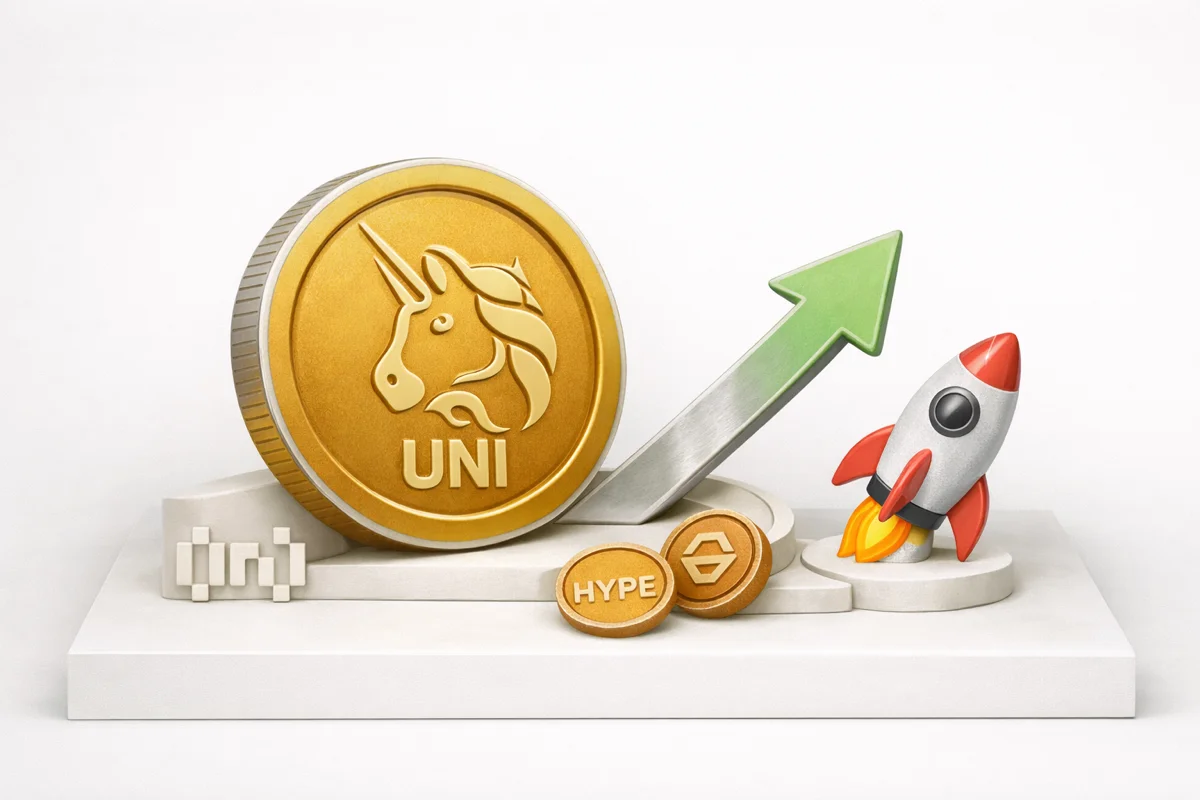
Uniswap's long-awaited protocol fee switch activation in late December 2025 marked a watershed moment for the DeFi's largest decentralized exchange. For the first time in Uniswap's history, a portion of swap fees flows directly to the protocol rather than exclusively to liquidity providers. Early data from the first 30 days of activation reveals a revenue trajectory that exceeds initial conservative projections, validating the fundamental shift from governance-only token to a value-accrual instrument. Simultaneously, the v4 hooks ecosystem continues to accelerate innovation in liquidity provision strategies, with four standout builders demonstrating the capital efficiency gains that differentiate modern DeFi from earlier exchange designs.
Understanding Uniswap's Fee Switch Activation
The UNIfication proposal passed with overwhelming support in late 2025, activating Uniswap's protocol fee switch beginning on Ethereum mainnet in December. The fee structure varies by pool tier: v2 pools now carry a 0.05% protocol fee while LP fees were reduced from 0.3% to 0.25%, and v3 pools yield tiered fractions — liquidity providers in 0.01% and 0.05% tiers relinquish one-quarter of their fees to the protocol, while higher-tier pools contribute one-sixth.
This activation represented far more than a mechanics change. The protocol executed a retroactive 100 million UNI treasury burn, establishing a precedent for direct value capture tied to protocol performance. Rather than accumulating fees in a Treasury vault, Uniswap has implemented a programmatic burn mechanism that converts protocol fees into permanent UNI destruction. This approach aligns the token's scarcity incentive with actual protocol economics, transforming UNI from a purely governance instrument into a direct beneficiary of Uniswap's trading activity.
Early Revenue Data: 30 Days of Real Value Accrual
The first thirty days of fee switch activation have validated Uniswap's revenue potential ahead of market expectations. Early January 2026 data from Coin Metrics implied approximately $26 million in annualized protocol fees, with a ~207x revenue multiple relative to the current token valuation. This projection was not merely theoretical—by February 2026, the protocol had already converted $5.5 million of collected fees into UNI burns, representing a $34 million annualized run rate and demonstrating that early trading patterns were sustaining the revenue thesis.
The Ethereum activation alone has been particularly robust. Ethereum-only Uniswap pools generated $3.3 million in protocol revenue since late December, while Unichain sequencer fees contributed an additional ~$5.52 million on an annualized basis. These numbers suggest that even before expanding beyond Ethereum, Uniswap has already locked in a meaningful revenue stream.
The protocol's ambitions extend further. A late-February 2026 governance vote targets fee switch expansion to eight additional Layer 2 networks, potentially adding approximately $27 million in annualized revenue. Combining projected earnings across Ethereum, alternative Layer 1 networks, and the expanded L2 footprint, total annualized protocol revenue could exceed $60 million—a substantial validation that the fee switch was worth the governance effort.
Base's Surprising Dominance: Shifting Fee Geography
One of the most striking revelations from the first 30 days of fee activation is the emergence of Base as Uniswap's leading fee-generating chain. Base traders have paid $55 million in total fees to Uniswap since January 1, 2026, surpassing Ethereum's contribution and signaling a significant shift in Layer 2 adoption patterns.
This outcome challenges conventional assumptions about Uniswap's architecture. For years, Ethereum mainnet was understood as Uniswap's primary value center, with Layer 2 networks treated as secondary venues for lower-stakes trading. The Base data suggests this hierarchy has inverted—or at minimum, that Layer 2 volumes are scaling faster than previously projected. This shift carries implications for Uniswap's multi-chain revenue strategy, governance prioritization, and the relative importance of different deployment targets as the protocol considers fee expansion beyond Ethereum.
The V4 Hooks Ecosystem: Innovation Through Customization
The underlying engine of Uniswap's long-term differentiation lies not in the fee switch itself, but in the v4 hooks architecture that enables builders to customize pool behavior at execution time. Hooks are external smart contracts that intercept pool lifecycle callbacks—beforeInitialize, afterInitialize, beforeSwap, afterSwap, and liquidity management events—allowing each hook to serve multiple pools and enabling customized AMMs, yield protocols, and lending integrations.
The adoption metrics validate hooks' potential. According to Uniswap ecosystem data, since the January 31, 2025 mainnet launch, over 2,500 custom pools have been deployed via hooks across 12 chains, and these pools have collectively processed more than $110 billion in cumulative trading volume. Hooks fundamentally alter liquidity provision economics by enabling capital efficiency innovations impossible in v2 or v3 architecture—strategies like dynamic fee structures, automated liquidity rebalancing, and rehypothecated lending integrations that compress the time and capital required to achieve competitive market-making.
Four Leading Hook Builders Reshaping DeFi Liquidity
The diversity of approaches among leading hook builders demonstrates the ecosystem's maturity.
Flaunch leads by total value locked, managing approximately $2.3 million in TVL across 24 deployed hooks. Designed as a memecoin launchpad with automated fee buyback mechanics, Flaunch has generated an estimated $75.6 million in trading volume across its v4 pools in the first 30 days of fee switch activation, showcasing how hooks can enable entirely new liquidity models.
Bunni v2 represents the most striking capital efficiency achievement. By routing LP capital to lending protocols via a rehypothecation hook, Bunni's flagship ETH-USDC pool on Base generated $80.76 million in trading volume over 30 days against only $27.68K in TVL—a 100x capital efficiency ratio compared to non-hooked pool equivalents. This outcome illustrates how hooks compress the capital requirements for efficient liquidity provision, enabling builders to serve traders at scale without proportional increases in locked funds.
Doppler by Whetstone Research addresses token launch liquidity, providing liquidity bootstrapping auctions that help new protocols achieve fair price discovery before transition to open trading.
Angstrom by Sorella Labs focuses on MEV mitigation, protecting liquidity providers against CEX-DEX arbitrage and toxic order flow—a critical consideration for risk-conscious LPs.
These four builders represent distinct strategic approaches, confirming that the hooks primitive is flexible enough to support multiple concurrent innovation vectors.
Standardizing Hook Data: Uniswap Foundation's Data Initiative
As the hooks ecosystem expanded, data fragmentation posed a barrier to unified analytics and integration. The Uniswap Foundation has moved to establish standardized hook events—HookSwap, HookFee, HookModifyLiquidity, and HookBonus—with TVL measured across Singleton, External, and Hook-specific variants, and volume tracked as Total, Hooked, and Vanilla pool activity. These standards enable consistent analytics, front-end integration, and ecosystem-wide visibility—preconditions for sustainable growth at scale.
What This Means: Fee Switch Validation and Future Trajectory
Thirty days of fee switch activation have validated what the governance community long hypothesized: Uniswap's fee switch was not merely a symbolic gesture toward token value capture, but the foundation of a structural shift in how the protocol generates and distributes economic returns.
The revenue trajectory—$26 million annualized in January, $34 million by February, with $60 million+ projected following L2 expansion—demonstrates that the fee switch was undersold relative to actual market demand. This validates the broader DeFi trend toward fee-linked token models with programmatic burns, positioning UNI as a direct beneficiary of protocol growth rather than a governance token disconnected from economic performance.
Simultaneously, the hooks ecosystem demonstrates that Uniswap's competitive moat has shifted from protocol mechanics alone to the ecosystem of builders layering customization on top. The four leading builders—Flaunch, Bunni, Doppler, and Angstrom—show that hooks unlock new liquidity strategies impossible under earlier architecture constraints. Capital efficiency gains demonstrated by Bunni and others suggest that hooks will drive sustained innovation cycles, enabling higher trading volumes at lower capital costs and fundamentally reshaping liquidity provision economics.
Conclusion
Uniswap's first 30 days post-fee activation mark a turning point in DeFi protocol economics. The fee switch has delivered measurable value to token holders through a transparent, automated burn mechanism, while the v4 hooks ecosystem continues accelerating innovation among a diverse builder community. As the protocol expands fee activation to additional chains, the combination of proven revenue performance and ongoing ecosystem growth positions Uniswap to maintain its leading market position through the cycle ahead.
Sources
- UNIfication — Uniswap Blog
- Uniswap finally turns the fee switch — Blockworks
- Uniswap Flips the Fee Switch: From Governance Token to Value Accrual | Coin Metrics
- Uniswap's UNI Jumps 15% as Governance Vote to Expand Fee Switch Gains Momentum | CoinDesk
- Hooks | Uniswap
- Bunni: How To Build a Leading Uniswap v4 Hook | Auditless Research
- Establishing Hook Data Standards for Uniswap v4 | Uniswap Foundation