TON Blockchain DeFi Ecosystem: TVL Milestones, Key Protocols, and Growth Signals
TON DeFi TVL ranges $300–335M in early 2026. Explore STON.fi dominance, cross-chain integration, RWA tokenization, and institutional backing fueling ecosystem maturation.

TON's DeFi ecosystem has undergone a significant maturation arc. After expanding from a single-protocol system to a diversified multi-protocol stack, the blockchain is now executing a strategic expansion into cross-chain liquidity, real-world assets, and institutional infrastructure. This article examines the current state of TON DeFi TVL milestones, the protocols driving adoption, and the infrastructure developments positioning TON as a credible alternative ecosystem in 2026.
Understanding TON's DeFi Ecosystem and Current TVL Landscape
As of early 2026, TON DeFi's total value locked (TVL) ranges between $300–$335M, representing a notable shift from the peak of approximately $776M reached in mid-2024. This TVL adjustment reflects market normalization rather than ecosystem weakness; the period from 2024 onward has witnessed the emergence of multiple specialized protocols addressing distinct DeFi primitives.
The ecosystem has matured considerably since 2024. What began as a predominantly staking-focused environment has evolved into a multi-layer stack comprising liquid staking, decentralized exchange (DEX) trading, lending protocols, and emerging real-world asset (RWA) infrastructure. Tonstakers, the largest TVL anchor, currently dominates the ecosystem with $186–250M in locked value—approximately 35% or more of total TON chain TVL. This concentration pattern is typical of nascent ecosystems, where a single high-yield product attracts the majority of capital while secondary protocols build complementary liquidity pools.
Leading DEX and Staking Protocols Driving Volume
STON.fi has emerged as TON's dominant decentralized exchange. Depending on market conditions, STON.fi's TVL fluctuates between $38M and $139M, with the protocol having accumulated over $6.8B in cumulative trading volume across more than 31M operations since its November 2022 launch. The exchange now serves a base of 5.6M users and facilitates trading across 30,000+ token pairs—a clear indicator of ecosystem maturity and user adoption depth.
Complementary protocols have filled specialized niches within the DeFi stack. EVAA Protocol, positioned as TON's first native lending protocol, achieved a peak TVL of $84M during Q1 2025. Meanwhile, DeDust's automated market maker (AMM) has processed over $3B in cumulative trading volume, establishing itself as a secondary yet substantial liquidity venue.
Tonstakers liquid staking deserves particular attention due to its outsized capital concentration. The protocol enables users to earn passive income—while retaining the utility of their underlying staked tokens through liquid staking receipts. This combination of yield and composability has made Tonstakers the ecosystem's anchoring TVL magnet.
Cross-Chain Integration: Bridging Bitcoin, Ethereum, and Beyond
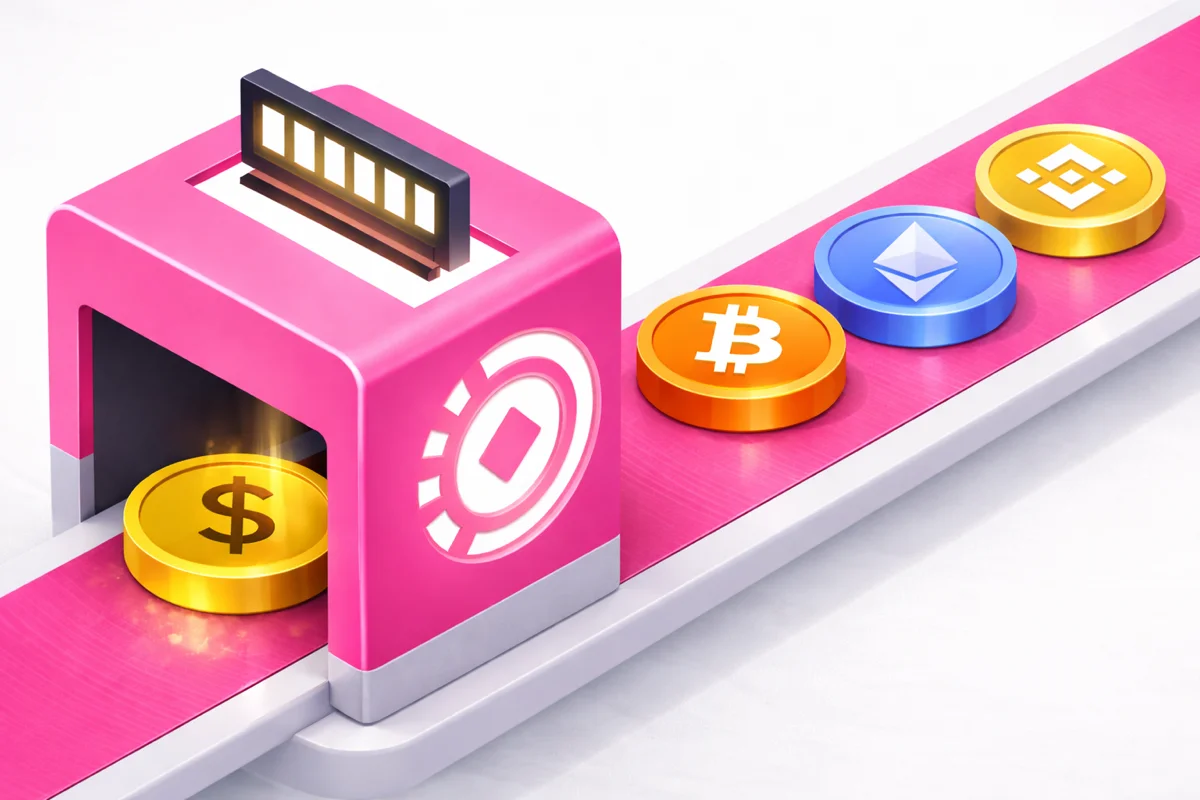
A pivotal shift occurred in early 2026 as TON's DeFi ecosystem gained direct access to Bitcoin and Ethereum capital. STON.fi integrated wrapped Ethereum (WETH) and Coinbase Bitcoin (cbBTC) as primary liquidity pairs in February 2026, launching initial liquidity pools for WETH/USDt and cbBTC/USDt trading. Simultaneously, Omniston's cross-ecosystem swap capability now enables traders to convert any TON-native token directly to BTC or ETH without multi-step bridging.
The technical foundation for this integration was laid in February 2025 when TON completed its LayerZero integration, establishing interoperability connections with 12 major blockchains—including Ethereum, Tron, Solana, and others. This infrastructure development coincided with major stablecoin launches: Ethena's $5B USDe arrived on TON, while Tether's USDT0 became natively transferable across TON, Tron, Ethereum, and Arbitrum without reliance on wrapped versions.
Infrastructure maturity was further validated when Chainlink designated TON as its canonical cross-chain standard in November 2025. This standardization signals institutional-grade confidence in TON's technical infrastructure and creates a reliable foundation for institutions deploying capital across multiple chains.
Prior bridge solutions demonstrate the liquidity impact of cross-chain infrastructure. Stargate's bridge, for instance, previously handled approximately $1.6B in monthly volume, illustrating the capital flows that cross-chain solutions can activate.
Real-World Assets Enter the TON DeFi Stack
A structural shift emerged in April 2025 when Libre Finance tokenized $500M of Telegram debt obligations as the Telegram Bond Fund (TBF) on TON. The fund targets an additional $2.35B in outstanding Telegram bonds, positioning TBF as the ecosystem's first significant real-world asset program. Libre's operational history includes prior tokenization of $200M+ in assets across institutional fund managers, establishing credibility for the program.
The RWA integration introduces a novel composability layer: tokenized bond units are available as collateral for on-chain borrowing, enabling institutional investors to generate secondary yield through DeFi lending protocols. This development signals that TON's DeFi ecosystem is evolving beyond purely crypto-native yield strategies into hybrid RWA+DeFi structures.
Building on this trend, tokenized U.S. equities became tradeable within Telegram wallets beginning in November 2025. This feature dramatically lowers friction for retail participants seeking exposure to traditional equities through a mobile-first interface, expanding the asset classes accessible through TON-based DeFi infrastructure.
Institutional Adoption and Funding Milestones
Capital deployment and institutional partnerships have accelerated throughout 2025 and into early 2026. STON.fi, the ecosystem's leading DEX, completed a $9.5M Series A funding round led by prominent venture firms Ribbit Capital and CoinFund. This signaling effect legitimizes TON's DeFi infrastructure in the eyes of institutional capital allocators.
Protocol-level support has been substantial. The TON Foundation committed $24M in DeFi liquidity incentives specifically allocated to STON.fi and DeDust, creating a structured economic incentive for liquidity providers during the ecosystem's growth phase. Secondary institutional partnerships include support from Coinbase Ventures and Bitstamp, both providing market access and credibility.
Perhaps most significantly, Standard Chartered's Zodia Custody division—a division of one of the world's oldest banking institutions—now provides custody infrastructure for TON assets. This custody partnership removes a critical infrastructure bottleneck for institutional participants and signals that traditional finance is increasingly viewing TON as a credible asset class.
Telegram Integration: The Ecosystem's Core Growth Moat
TON's competitive advantage rests fundamentally on its position as the exclusive blockchain for Telegram's mini-app ecosystem. Telegram's user base exceeds 900M monthly active users globally, and TON is the designated blockchain layer for this entire suite of mini applications. This distribution relationship is unmatched among competing Layer 1 blockchains.
User adoption metrics underline the growth trajectory. Daily transaction counts increased 13-fold during 2024, while the count of active wallets rose 30-fold over the same period. These growth metrics suggest that Telegram's integration is producing measurable adoption acceleration, though from a modest absolute base.
Friction reduction has become a strategic priority. COCOON, a confidential compute open network (COCOON AI), launched specifically for Telegram's 900M users in late 2025, providing AI-assisted onboarding and asset management tools. MoonPay's cross-chain deposit functionality further simplifies the on-ramp process for Telegram wallet users, allowing direct conversion from fiat currency to TON-based assets with minimal friction.
Structural Challenges and Future Outlook
Despite the ecosystem's demonstrated growth, concentration risks merit acknowledgment. Tonstakers' dominance—holding 35% or more of total TON TVL—creates a structural imbalance where a single staking product captures the majority of ecosystem capital. While passive staking is a legitimate DeFi primitive, ecosystem health typically benefits from capital distribution across multiple use cases.
DEX liquidity and trading volumes, while growing, remain modest in comparison to Ethereum Layer 1 peers and leading Layer 2 networks. The cross-chain integration and BTC/ETH bridge access discussed above are explicitly designed to address this structural constraint by attracting external capital.
Momentum in developer adoption provides a contrasting positive signal. The TON Builders Portal has onboarded 166 new projects despite the TVL fluctuations observed in aggregate metrics. This suggests that developer interest and long-term ecosystem building activity remain intact despite short-term capital volatility.
Conclusion
TON Blockchain's DeFi ecosystem in 2026 represents a maturing alternative to Ethereum-dominant DeFi infrastructure. The combination of institutional backing—evidenced by venture capital funding, custody partnerships, and protocol-level incentives—alongside structural innovations in cross-chain integration and real-world asset tokenization positions TON as more than a speculative proposition. The Telegram distribution moat, validated through measurable growth in daily transactions and active wallets, provides TON with a distribution advantage most competing Layer 1 blockchains lack.
Capital allocation decisions should reflect both the demonstrated institutional confidence and the ecosystem's structural challenges. TVL concentration in staking and modest DEX liquidity remain constraints that require ongoing attention. However, the convergence of Telegram's billion-user distribution network, institutional-grade infrastructure, and transparent protocol development creates conditions for sustained, if incremental, ecosystem growth throughout 2026.
Ready to explore TON DeFi opportunities? Track real-time TVL data, protocol metrics, and liquidity pools on authoritative platforms like DeFiLlama, monitor upcoming institutional integrations through TON Foundation announcements, and consider how cross-chain composability might unlock new yield strategies in your portfolio. As the TON ecosystem matures, staying informed on protocol developments and cross-chain bridges will be essential for capitalizing on emerging opportunities.