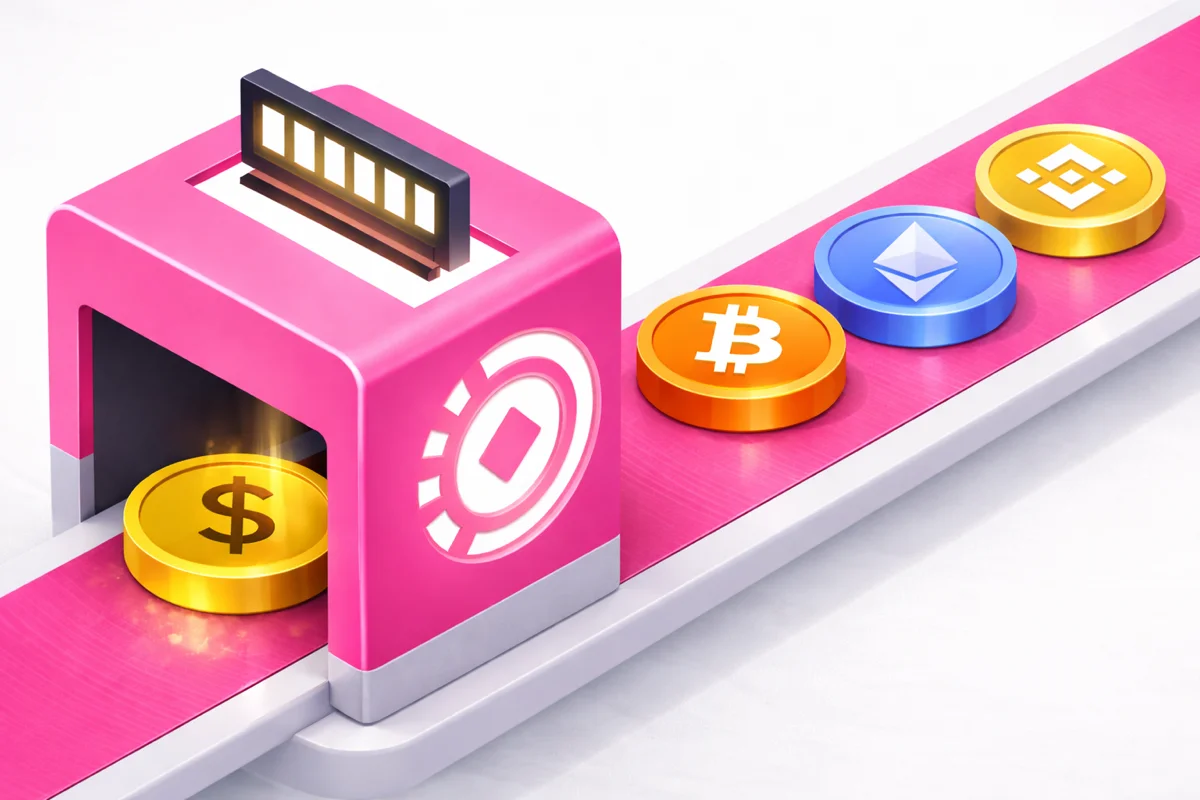
Pendle Settles $58B Fixed Yield (161% Growth) — Why Rate Volatility Wins
Fixed income on-chain: Pendle's yield tokenization enables 17% WBTC yields, rate hedging, and $58B settled volume. Explore the institutional thesis behind V3 Boros.
Fixed income markets in traditional finance represent decades of institutional capital allocation and risk management. Today, Pendle Finance fixed yield markets are bringing this trillion-dollar practice on-chain through innovative yield tokenization. The protocol enables both retail and institutional investors to lock in predictable returns while hedging interest rate volatility—mechanisms previously unavailable in decentralized finance.
This deep dive explores how Pendle's tokenization architecture works, why interest rate uncertainty amplifies the protocol's utility, and what V3 Boros means for institutional adoption of on-chain fixed income.
What is Pendle Finance? Understanding Yield Tokenization
Pendle Finance is a permissionless yield-trading protocol that democratizes interest derivative markets on-chain. The protocol addresses a fundamental challenge: yield-bearing assets like stETH, liquid staking tokens (LSTs), and Aave deposits generate variable returns that fluctuate with market conditions. Pendle solves this by splitting these assets into two separate, tradeable tokens.
The core mechanism works through three steps:
- Standardized Yield Wrapping (SY): Any yield-bearing token is wrapped into a standardized format, normalizing interfaces across different protocols.
- Token Splitting: The SY token is then split into two components:
- PT (Principal Token): Represents the principal amount, redeemable 1:1 at maturity
- YT (Yield Token): Represents all future yield generated until maturity
This split tokenization unlocks multiple use cases: fixed yield strategies, yield speculation, and enhanced liquidity provider returns. Pendle currently operates across Ethereum, Arbitrum, Optimism, and BNB Chain, with expansion planned for additional networks.
How Principal Tokens Work: Locking in Fixed Returns
Principal Tokens function as zero-coupon bonds within the DeFi ecosystem. When an investor purchases a PT, they buy it at a discount to its face value. At maturity, the token redeems for exactly 1:1 against the underlying asset.
The mathematics behind PT pricing create a fixed return guarantee. If a PT is purchased for $95 and redeems for $100 at maturity in one year, the buyer has locked in a 5.26% annual return—regardless of how much yield the underlying asset actually generates. This fixed return equals the implied APY at the time of purchase, offering complete protection against yield volatility.
The time-decay mechanics are essential to PT's design. As maturity approaches, the price difference between purchase and redemption shrinks. The PT price naturally converges toward its redemption value over time. This mechanism requires no external oracle feeds—time-decay is built directly into the AMM bonding curve. This oracle-independence removes a critical dependency that plagues other DeFi fixed-income protocols.
Yield Tokens and Rate Speculation
If Principal Tokens enable conservative capital preservation, Yield Tokens unlock rate speculation. YT tokens grant holders pure exposure to all future yields generated by the underlying asset until maturity—without requiring them to lock up capital.
YT holders effectively bet on interest rate movements. If yields rise or remain elevated, YT tokens increase in value. If yields fall, YT value declines. This creates a hedging mechanism previously unavailable in DeFi. Borrowers who want to fix their borrowing costs can buy PT (locking in stable rates), while lenders can buy YT to amplify yield exposure.
The market dynamics mirror traditional interest rate swaps—a TradFi market estimated at over $579 trillion in notional value. By splitting yield into two tradeable components, Pendle creates two-sided markets: PT buyers want rates to fall (increasing redemption appeal), while YT buyers want rates to stay elevated or rise (maximizing future yield).
Interest Rate Discovery Without Oracles
Pendle's custom AMM represents a significant innovation in yield market infrastructure. The mechanism is purpose-built for yield tokens and uses concentrated liquidity to minimize impermanent loss for liquidity providers.
The most powerful feature is Implied APY discovery. The Implied APY is derived directly from the market prices of PT and YT tokens—creating an organic, on-chain interest rate discovery mechanism. Rather than relying on centralized price feeds, the protocol extracts rate expectations from on-chain trading activity.
The AMM accounts for both time-decay and interest rate expectations simultaneously. This dual functionality prevents yield token mispricing over time while ensuring fair pricing without external oracle dependency. For institutional investors, this oracle-free design reduces systemic risk and improves protocol transparency.
Rate Uncertainty: Why Market Volatility Powers Pendle
This section addresses a counterintuitive dynamic: Pendle becomes more valuable, not less valuable, during periods of interest rate uncertainty.
Global interest rate derivatives exceeded $579 trillion in notional value during 2024, historically confined to institutional TradFi markets. Pendle brings this same hedging utility permissionlessly on-chain.
During volatile rate environments, both sides of the market become attractive. When rates are elevated and investors fear decline, locking in today's high rates via PT becomes immediately appealing. Simultaneously, YT trading increases as traders position for various rate scenarios. Both effects deepen liquidity and increase demand for the underlying yield tokens.
Yield tokenization enables borrowers and lenders to hedge interest rate volatility—a hedging mechanism previously unavailable in DeFi markets. This creates a self-reinforcing cycle: as rate volatility increases, so does demand for fixed-rate exposure and rate speculation, which in turn drives protocol growth and fee generation.
Pendle V3 Boros: Funding Rates and Institutional Expansion
Pendle V3, branded as Boros, represents the next evolutionary step in the protocol's architecture. Launched in early 2025, Boros extends yield tokenization beyond staking and lending yields to funding rates in perpetual futures markets.
Perpetual futures markets generate approximately $150–200 billion in daily volume, yet funding rates remain fragmented across individual exchanges. Boros allows traders to trade crypto funding rates with margin, enabling protocols like Ethena to lock in predictable yield streams. Hedgers can fix their perpetual funding exposure, while yield farmers can speculate on funding rate movements.
The numbers validate Pendle's traction: according to Blockworks, Pendle settled $58 billion in fixed yield by 2025, representing 161% year-over-year growth, and generated $40 million in annualized revenue—demonstrating sustainable unit economics.
Institutional adoption is accelerating through KYC-compliant infrastructure called Citadels. These facilities offer regulated access to on-chain fixed income products. Current on-chain WBTC yields reach 17%, directly competing with traditional corporate bonds yielding 8%. This yield advantage positions Pendle as a credible fixed-income alternative for institutional capital allocation.
Pendle's roadmap signals ambitious expansion across multiple chains. Planned launches on Solana, Hyperliquid, and TON position the protocol as crypto's universal interest rate layer, accessible across fragmented blockchain ecosystems.
Smart Contract Risk and Security Considerations
For institutional investors evaluating Pendle, smart contract risk remains the primary operational concern. Pendle maintains security through multiple third-party audits and bug bounty programs across all deployments.
Composability risk warrants specific attention. When external protocols build on top of Pendle's yield tokens, they introduce additional attack vectors. The 2024 Penpie exploit, which resulted in $27 million in losses, demonstrated that composability risks can propagate to platforms leveraging Pendle's infrastructure. Institutional evaluators should review audit reports and understand the risk vectors introduced by integrated protocols.
Smart contract risk is quantifiable and manageable through thorough code review and audit analysis. For yield-bearing strategies, understanding the complete chain of dependencies—from base protocol through intermediary layers to final deployment—remains essential before committing institutional capital.
Pendle Finance has established itself as a leading DeFi fixed-income protocol by solving a fundamental market need: the ability to separate and trade interest rate risk independently. PT and YT tokenization enables locked-in returns for conservative investors while creating yield speculation markets for traders—all without oracle dependency.
The protocol's strength emerges precisely when rate uncertainty peaks. During volatile macro conditions, both fixed-rate seekers and rate speculators demand liquidity, deepening markets and increasing protocol revenue. With V3 Boros expanding to funding rates and Citadels opening institutional access, Pendle is positioning itself as the universal interest rate layer across crypto.
For investors and protocols considering fixed-income alternatives on-chain, understanding Pendle's mechanics and evaluating smart contract risk are essential first steps toward institutional-grade yield management.