How to Use Pendle Finance to Lock In Fixed DeFi Yields on stETH, eETH, and USDe
Learn how to lock in fixed yields on Pendle Finance with stETH, eETH, and USDe. Step-by-step tutorial covering mechanics, asset-specific strategies, and key risks.
DeFi yield farming is powerful but unpredictable. Your staking rewards fluctuate with market conditions, and variable-rate protocols introduce uncertainty into portfolio planning. Pendle Finance solves this by enabling you to lock in fixed yields on your favorite assets. Whether you hold stETH from Lido, eETH from Ether.fi, or USDe from Ethena, Pendle's yield tokenization mechanics let you separate fixed returns from variable yield exposure—and trade them independently.
This tutorial covers how Pendle works, why you'd use it, and step-by-step instructions to lock in guaranteed returns across three major DeFi assets.
What is Pendle Finance and Yield Tokenization
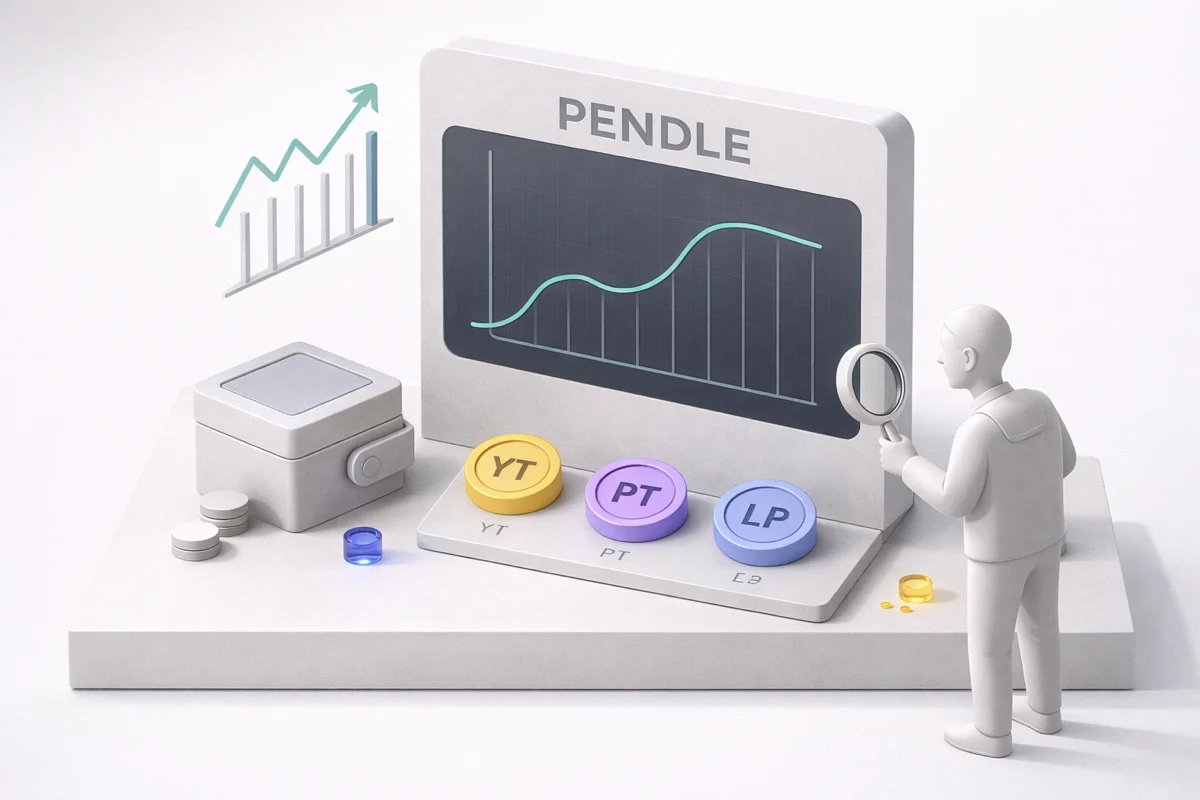
Pendle is a permissionless yield-trading protocol that wraps yield-bearing tokens into SY (Standardized Yield), then splits them into two distinct instruments: PT (Principal Token) and YT (Yield Token). This separation brings interest derivative markets from traditional finance into DeFi, a structure already used across $400 trillion in notional TradFi products.
The core mechanic is simple: you deposit a yield-bearing asset and receive both PT and YT in equal amounts. PT acts like a zero-coupon bond—purchased at a discount, redeemed at par value at maturity. This discount directly implies a fixed APY. Buying PT locks in a fixed return regardless of how the underlying asset's APY fluctuates in the meantime.
The protocol has grown significantly: Pendle's Total Value Locked (TVL) reached $8.9 billion as of 2025, reflecting the strong demand for fixed-yield instruments in DeFi.
Understanding Principal Tokens (PT) vs Yield Tokens (YT)
To use Pendle effectively, you need to understand how PT and YT function separately.
Principal Tokens (PT) hold the principal value and appreciate from their discounted purchase price to par (1:1 redemption) at maturity. When you buy PT-stETH at 0.95 ETH, for example, it redeems for exactly 1 ETH at maturity—locking in approximately 5.26% fixed return. The price discount reflects market expectations about future yields: lower PT price means higher implied APY.
Yield Tokens (YT) capture all yield or rewards accrued until expiration, then become worthless. If you hold YT-stETH, you receive all staking rewards until maturity, then your YT has no value. This separation allows sophisticated users to separate fixed-return (PT) from variable-return (YT) strategies.
Splitting yield-bearing assets in this way lets individual investors and traders optimize for their specific risk appetite: some want certainty (PT buyers), others want maximum yield exposure (YT buyers).
Locking Fixed Yield on stETH with Pendle
Lido's stETH is the largest liquid staking derivative on Ethereum. Using Pendle, you can lock in a fixed ETH-denominated yield instead of tracking the volatile staking APY.
How it works: Deposit stETH into Pendle to receive PT-stETH and YT-stETH in equal amounts. PT-stETH locks in Ethereum's staking yield for your chosen maturity period. The PT price discount directly reflects the fixed APY offered at maturity.
Who should use it: This strategy is ideal for Ethereum stakers seeking predictable, variable-free returns. If you want to plan cash flows with certainty rather than track yield fluctuations week to week, PT-stETH provides that certainty.
Selling the yield: You can sell your YT-stETH to other traders who want variable yield exposure, recovering some of your capital immediately while PT continues to maturity.
Locking Fixed Yield on eETH with Pendle
Ether.fi's eETH combines traditional Ethereum staking with additional restaking rewards via EigenLayer. Pendle lets you lock in both staking and restaking yield in fixed form.
How it works: When you deposit eETH into Pendle, you receive both PT-eETH and YT-eETH. Notably, 1 eETH converts to 1.088 PT-eETH redeemable at maturity. This conversion ratio captures locked-in staking and restaking yield.
Trade-off: eETH users gain certainty on ETH-denominated returns but forfeit EigenLayer and Ether.fi loyalty points when they lock in fixed yield. This strategy is useful for liquid restaking strategies requiring predictable yield outcomes. PT-eETH pricing reflects Ether.fi's current staking and restaking APY, so you can evaluate whether locking in the current rate meets your return threshold.
Locking Fixed Yield on USDe and sUSDe
USDe and its staking derivative sUSDe represent the dominant use case on Pendle. USDe/sUSDe derivatives make up approximately 75% of Pendle's TVL, reflecting the protocol's dominant position in dollar-denominated fixed yield.
Base yield: Ethena's sUSDe earns approximately 9% APY from its delta-neutral funding rate strategy. This consistent yield makes it attractive for risk-averse DeFi users seeking stablecoin returns without price volatility.
Fixed yield with Pendle: Buying PT-sUSDe locks in 8–11% fixed APY. You get certainty on stablecoin yields—valuable for treasury management and predictable income.
Advanced strategy—Aave looping: Experienced users employ a looping strategy: deposit PT-sUSDe as Aave collateral, borrow stablecoins, buy more USDe, and repeat. Theoretically, this can amplify yields to ~60% at 9x leverage. However, this strategy introduces significant liquidation risk and is not appropriate for users unfamiliar with margin mechanics.
Step-by-Step: How to Lock In Fixed Yield on Pendle
Ready to lock in fixed yield? Follow these steps:
-
Connect your wallet to Pendle.finance. Ensure you have enough of your chosen asset (stETH, eETH, or USDe) and some ETH for gas fees.
-
Select your asset pool. Choose the yield-bearing asset and maturity date you want. Review the implied fixed APY from the PT price discount to evaluate whether the locked-in rate justifies taking maturity risk.
-
Approve and deposit. Deposit your asset into the SY wrapper to receive equal amounts of PT and YT in return.
-
Trade if desired. You can buy additional PT on the Pendle AMM if you want more fixed-yield exposure at the current market price, or sell your YT to recover capital.
-
Hold to maturity. Hold PT until maturity, then redeem 1:1 for the underlying asset plus accrued gains.
-
Early exit option. If you need to exit before maturity, you can sell PT on the AMM. Be aware that early exit may result in favorable or unfavorable returns depending on current market conditions for PT.
Key Risks and Risk Management
Fixed yield sounds risk-free, but Pendle strategies carry distinct risks worth understanding.
Smart contract risk: Pendle, Lido, Ether.fi, and Ethena all carry protocol-level vulnerabilities. A critical exploit in any of these protocols could result in loss of funds.
Early exit penalty: Selling PT before maturity may result in unfavorable returns. PT price moves with market rates; if rates rise, PT prices fall, and early sellers realize losses.
Discount rate risk: PT price shifts with market interest rates, affecting collateral value if you use PT as collateral in leveraged strategies like Aave looping.
Liquidation risk: Looping strategies at high leverage face margin calls if PT or borrow token prices move against you.
Concentration risk: USDe's dominance (75% of Pendle TVL) creates systemic exposure to Ethena's operational health.
Best practice: Use fixed yield for the portion of your portfolio you can hold to maturity. Avoid leverage if you are unfamiliar with liquidation mechanics and margin calls.
Ready to lock in yield? Start with a small position on your preferred asset, hold it to maturity to understand the mechanics, and scale up as you gain confidence with Pendle's interface and liquidity pools.