GENIUS Act Implementation: OCC Proposes Rules That Could Restrict Stablecoin Yield — What DeFi Needs to Know
OCC's 376-page NPRM to implement the GENIUS Act bans stablecoin yield and targets affiliate workarounds — but DeFi protocols have explicit statutory safe harbors.
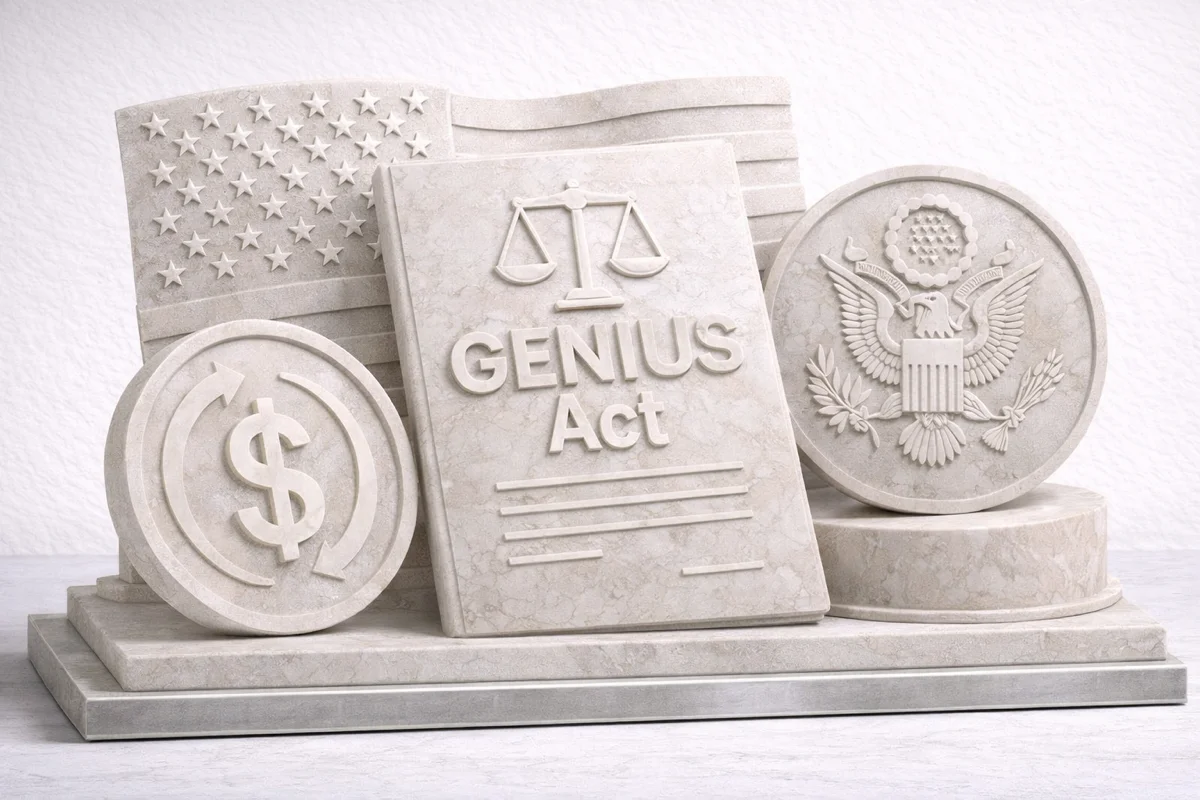
The U.S. Office of the Comptroller of the Currency has released one of the most consequential stablecoin rulemakings in American history — and some of its provisions are aimed directly at how crypto platforms currently make money from stablecoins. Here is what the rules say, what they threaten, and why DeFi protocols may be better protected than the headlines suggest.
What the OCC Just Proposed — and Why It Matters Now
On February 25, 2026, the OCC published a 376-page Notice of Proposed Rulemaking (NPRM) to implement the GENIUS Act, which was signed into law on July 17, 2025. [1] The GENIUS Act is the first comprehensive U.S. federal stablecoin framework, and this rulemaking is the primary vehicle for translating its statutory provisions into enforceable regulatory requirements. [2]
The comment period runs 60 days from Federal Register publication. The statutory deadline for finalizing regulations is July 18, 2026, with the full regulatory regime required to be operational by January 18, 2027. [1] The White House set March 1, 2026 as a deadline for banks and the crypto industry to resolve disagreements over the yield prohibition — a deadline that arrived with no public resolution. [3]
This is not a distant regulatory future. The implementation clock is running, and the decisions made in the next six months will define the stablecoin market structure for years.
The Yield Ban: What the Rules Say and What They Target
The most operationally significant provision in the OCC's proposed rules is the yield prohibition. The proposed rules explicitly prohibit payment stablecoin issuers from distributing any yield or interest tied to stablecoin ownership or transaction activity. [5]
The prohibition does not stop at the issuer. The OCC creates a regulatory presumption that affiliate and third-party yield arrangements also violate the prohibition. [3] This means that a crypto platform cannot simply restructure its reward program through a separate entity to escape the rule — the OCC has anticipated that approach and built a presumption against it into the rulemaking itself. [4]
The practical target is clear. Coinbase's USDC rewards program, which currently offers users approximately 4% APY (Annual Percentage Yield), is precisely the kind of arrangement the OCC's affiliate presumption is designed to address. [3] The yield ban, as proposed, extends from issuers to intermediaries and reward-sharing platforms — anyone in the distribution chain who passes stablecoin economics to holders.
The rationale the OCC advances is that payment stablecoins should function like digital cash, not interest-bearing instruments. Allowing yield, in the OCC's view, blurs the line between payment instruments and securities or deposits, creating systemic ambiguity the agency believes the GENIUS Act was designed to eliminate.
Reserve Requirements and Capital Rules: The Operational Baseline
Beyond yield, the OCC's proposed rules establish a detailed operational baseline for any entity that wants to be a federally regulated payment stablecoin issuer.
The reserve requirement is 100%: every payment stablecoin in circulation must be backed one-for-one with high-quality liquid assets. Qualifying assets include cash, balances held at Federal Reserve Banks, short-dated U.S. Treasuries, qualifying repurchase agreements, and government money market funds. [5] Issuers must be able to redeem stablecoins at par value within two business days. [2]
Capital requirements for de novo federal qualified payment stablecoin issuers start at a statutory floor of $5 million. The OCC is explicit that this is a minimum, not a safe harbor — regulators retain discretion to impose higher requirements based on the scale and risk profile of individual issuers. [5]
The NPRM also includes requirements for audit, risk management, and custody arrangements, though the specific standards for those areas remain subject to comment. [2] The 376-page document covers the full operational lifecycle of a compliant stablecoin issuer — from charter application through ongoing supervisory obligations.
DeFi's Explicit Safe Harbor: What the GENIUS Act Protects
One aspect that receives less attention in most coverage: DeFi protocols have explicit statutory protections baked into the GENIUS Act itself.
The GENIUS Act explicitly excludes distributed ledger protocols, liquidity pool participants, validators, node operators, and self-custodial wallet interfaces from the definition of "digital asset service provider." [8] This is not a regulatory interpretation — it is a statutory carveout written into the law that the OCC's proposed rules implement. DeFi protocols are not payment stablecoin issuers under the GENIUS Act. They are outside the regulatory perimeter the proposed rules establish.
Liquidity pools that hold or deploy stablecoins are not subject to the yield prohibition in their capacity as pool operators. Validators and node operators who process stablecoin transactions are not classified as service providers subject to licensing. Self-custodial wallet interfaces that allow users to manage their own stablecoin holdings are explicitly excluded. [8]
This is a meaningful legal protection — and it reflects sustained lobbying work by organizations like the DeFi Education Fund during the GENIUS Act's legislative process. The exclusions were not accidental; they were specifically negotiated to ensure that decentralized infrastructure does not get swept into a bank-style regulatory framework designed for centralized issuers.
The important caveat: legal ambiguity remains for hybrid or semi-custodial models. A protocol that issues its own stablecoin, operates custodial pools, or provides services that blur the line between protocol and issuer may not be cleanly covered by the statutory exclusions. DeFi projects in those categories need legal review.
Business Model Threat: Coinbase, Circle, and the $1.3B Revenue Question
The stakes for centralized crypto platforms are large. Coinbase reported $1.3 billion in stablecoin revenue in 2025, with a meaningful portion tied to USDC-related arrangements including the approximately 4% APY rewards program currently offered to users. [6]
Bloomberg analysts estimated that Coinbase's USDC-related revenue could grow 2–7x if GENIUS Act implementation were favorable. [6] The OCC's proposed rules represent the unfavorable scenario for that analysis. The affiliate presumption directly threatens the reward structure regardless of how it is legally organized.
The competitive landscape is also shifting around stablecoin compliance. USDT, issued by Tether as a foreign entity, is not GENIUS Act–compliant and falls outside the U.S. regulatory perimeter. USDC, issued by Circle, is positioned as the primary compliant dollar stablecoin. Tether is also developing USA₮, a bank-issued U.S. token designed to meet GENIUS Act standards. [3]
This creates a bifurcated market: compliant issuers subject to the full weight of OCC regulation, and non-compliant foreign issuers operating outside U.S. regulatory reach. The OCC rules do not eliminate USDT from DeFi liquidity pools — but they do create a clear regulatory distinction that could affect which stablecoins centralized U.S. platforms are willing to support.
The Lobbying War: Banks vs. Crypto Over Deposit Competition
The yield prohibition is not just a technical regulatory question — it is the focal point of an active lobbying war between the banking industry and the crypto sector.
Blockchain Association CEO Summer Mersinger publicly accused banks of mounting a "relentless pressure campaign" to protect their incumbency through the GENIUS Act's yield prohibition. [7] The argument from the banking side is that stablecoin yield competes directly with bank deposits, undermining monetary policy transmission and giving unregulated entities a structural advantage in deposit-gathering. The argument from the crypto side is that the yield ban kills consumer benefit and innovation without any corresponding systemic risk reduction.
The White House played an active role, setting a March 1, 2026 deadline for the two sides to reach resolution. [3] No public agreement has been announced.
In parallel, the National Credit Union Administration proposed its own rule allowing credit unions to become permitted payment stablecoin issuers, with a comment period closing April 13, 2026. [7] The multi-agency nature of stablecoin regulation — OCC for national banks and federal stablecoin issuers, NCUA for credit unions, Federal Deposit Insurance Corporation (FDIC) for state-chartered institutions — means that the final regulatory picture will emerge from multiple simultaneous rulemakings, not just the OCC's NPRM.
The outcome of the lobbying fight will determine whether the yield prohibition survives in its current form, is modified with exceptions, or is substantially rewritten before finalization in July 2026.
Timeline and Action Items for DeFi Operators
For DeFi protocols and ecosystem participants, the immediate obligations are limited — but the monitoring requirements are significant. Here is the operational timeline:
Now through ~April 2026: The OCC's 60-day comment period is the key near-term window. Any DeFi protocol, infrastructure provider, or ecosystem participant with a view on the proposed rules — especially on the DeFi exclusions, the yield prohibition scope, or the affiliate presumption — should prepare and submit comments directly to the OCC. Comment periods on rules of this magnitude are genuinely influential. [1]
April 13, 2026: NCUA comment period closes for the parallel credit union stablecoin issuer rulemaking.
July 18, 2026: Statutory deadline for the OCC (and other agencies) to finalize regulations implementing the GENIUS Act. Expect a final rule — or at minimum a substantially revised NPRM — by this date. [1]
January 18, 2027: Full implementation deadline. The regulatory regime must be fully operational, and all qualifying payment stablecoin issuers must be in compliance.
For DeFi-specific due diligence: Protocols with hybrid custodial or issuer-adjacent functions should conduct legal review of their positioning relative to the GENIUS Act exclusions before Q3 2026. [8] The statutory exclusions are robust for purely decentralized infrastructure, but the line between protocol and service provider is not always clean. Protocols that integrate directly with USDC or that interact with centralized issuers should monitor OCC comment period outcomes closely — the final rules could affect the terms under which compliant stablecoins can be used in decentralized contexts.
The GENIUS Act's DeFi exclusions are a win for the ecosystem. The OCC's yield prohibition is a threat to centralized platforms but not, in its current form, to decentralized protocols. The 60-day comment period is the industry's best lever to shape the final rules before they lock in for years.
This article is based on publicly available regulatory filings and industry reporting as of March 1, 2026. It does not constitute legal advice. DeFi operators with specific compliance questions should consult qualified legal counsel.
Sources
[1] OCC Requests Comments on Proposal to Implement GENIUS Act — https://www.occ.treas.gov/news-issuances/news-releases/2026/nr-occ-2026-9.html (U.S. Treasury, February 25, 2026)
[2] OCC Lays Out Framework for Regulated Stablecoins Under GENIUS Act — https://decrypt.co/359188/occ-framework-regulated-stablecoins-genius-act (Decrypt, February 25, 2026)
[3] U.S. regulator's GENIUS pitch puts dark cloud over crypto sector's stablecoin model — https://www.coindesk.com/policy/2026/02/26/u-s-regulator-s-genius-pitch-puts-dark-cloud-over-crypto-sector-s-stablecoin-model (CoinDesk, February 26, 2026)
[4] OCC Proposes Stablecoin Rules To Implement GENIUS Act — https://bitcoinist.com/occ-genius-act-stablecoin-yield-workarounds/ (Bitcoinist, February 26, 2026)
[5] GENIUS Act Regulations: Notice of Proposed Rulemaking — https://www.occ.gov/news-issuances/bulletins/2026/bulletin-2026-3.html (OCC, February 25, 2026)
[6] Banking Regulator Floats New Stablecoin Yield Rules—Do They Hurt Coinbase? — https://decrypt.co/359506/banking-occ-new-stablecoin-yield-rules-coinbase (Decrypt, February 27, 2026)
[7] Crypto industry and banks clash over stablecoin bill — https://thehill.com/policy/technology/5689481-crypto-banking-lobbying-fight/ (The Hill, February 26, 2026)
[8] GENIUS Act Signed Into Law, Ushering in First Federal Digital Assets Framework — https://www.defieducationfund.org/genius-act-signed-into-law-ushering-in-first-federal-digital-assets-framework/ (DeFi Education Fund, July 17, 2025)