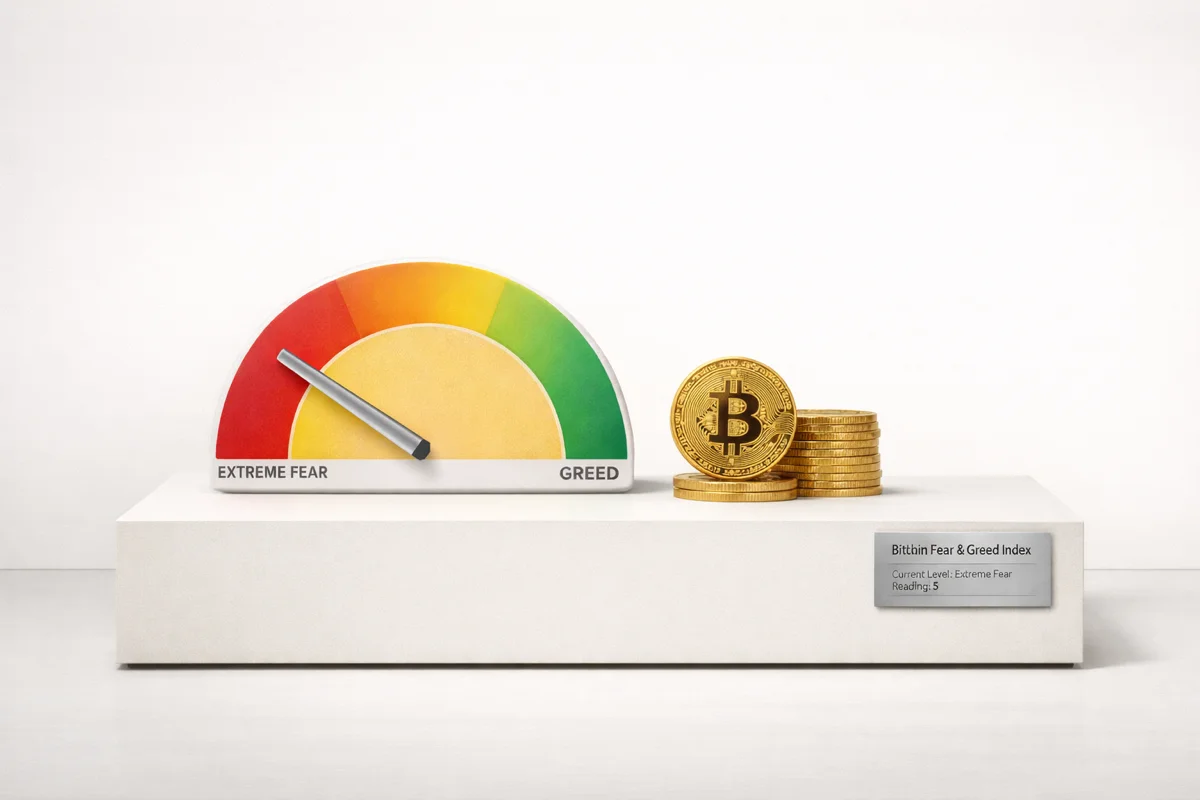
DeFi TVL Drop of 25%: Reading On-Chain Signals to Distinguish Bear Rotation from Structural Exodus
Analyze whether DeFi's recent 25% TVL decline signals capital exodus or cyclical rotation. On-chain metrics reveal structural growth amid price-denominated pullback.

The DeFi TVL drop of 2026 presents a deceptively simple headline: total value locked has plummeted from peaks near $130B to $94.7B, a contraction that instinctively reads as crisis. But on-chain signals tell a more nuanced story that separates price-denominated distortion from genuine capital exodus. Understanding this distinction is critical for investors assessing whether DeFi is in tactical rotation or structural retreat.
The Paradox: Why a 25% TVL Drop Isn't What It Seems
DeFi TVL fell to $94.7B from the $125–130B range observed in Q4 2025 and early 2026. On the surface, this suggests a crisis of confidence. Yet the on-chain evidence reveals a more important distinction: price-denominated distortion masks stable—and in some cases, expanding—underlying participation.
The critical analytical question is whether users are exiting DeFi entirely or experiencing portfolio mark-to-market decline. This distinction determines whether the current environment represents tactical rotation (temporary, price-driven) or structural collapse (permanent capital flight). The data leans decisively toward the former.
Price-Denominated TVL: The Misleading Metric
TVL measured in USD dollars serves as a proxy for ecosystem health, but it conflates two distinct dynamics: the number of tokens deposited and their price. When ETH dropped 38%, AAVE fell 40%, and LDO declined 50% through late 2025, TVL measured in USD fell proportionally—even if the actual token quantities remained stable.
The November 2025 TVL decline exemplifies this pattern. A $55B TVL drop was driven entirely by asset price depreciation, not user exits. Meanwhile, DEX (Decentralized Exchange) volumes surged to $360B for the month, exceeding June's full-month record. This divergence—falling USD TVL paired with rising transaction volume—is diagnostic of price-driven contraction, not participation collapse.
The effect manifests even more clearly in single-protocol metrics. Aave TVL nearly doubled year-over-year despite the USD-denominated pullback. The protocol's underlying asset quantities expanded materially while its USD valuation fell; the dollar TVL metric alone obscures this structural improvement.
ETH Deployment: The Honest Signal of User Participation
A more reliable on-chain signal is ETH quantity, which strips away price volatility. ETH in DeFi rose from 22.6M to 25.3M since January 2026. More striking: 1.6M ETH entered DeFi in a single week during the February sell-off—precisely when headline TVL was declining sharply.
This inverse relationship—growing ETH deposits amid falling USD TVL—directly contradicts the structural exodus thesis. The quantity signal reveals that sophisticated market participants are increasing exposure to DeFi, not reducing it. Yield seekers are maintaining delta-neutral positions at 3–5% annual yields, treating current conditions as an accumulation opportunity rather than a crash.
Real ETH quantities indicate that the underlying market structure is strengthening, not weakening. This is the honest signal beneath the USD TVL noise.
Stablecoin Supply: The Dry Powder Accumulation Signal
Stablecoin supply divergence reveals capital positioning intent. Total stablecoin supply reached $309.46B with weekly net mints of $741.6M.
The crucial pattern: stablecoin supply is growing while USD TVL declines. This is the clearest structural signal of dry powder accumulation, not capital exit. Traders are converting volatile assets into stablecoins, building cash reserves while waiting for better entry points—classic behavior during market downturns, not panicked liquidation.
Pantera Capital's recent analysis identifies stablecoin supply as the leading indicator that separates genuine adoption from purely speculative flows. Growing stablecoin reserves during a TVL pullback suggest traders are positioning for the next leg of the market cycle, not abandoning DeFi infrastructure altogether.
Liquidation Risk and Market Health Metrics
DeFi market health can be assessed through forced liquidation pressure, which reveals how leveraged and precarious positions have become. Only $53M in DeFi positions face liquidation within 20% of current prices, compared to $340M at risk during February 2025. This represents a 6.4x reduction in liquidation exposure—an improvement in market positioning quality despite lower headline TVL.
Lending utilization sits at 35.5% with $37.6B in available lending capacity, indicating an uncrowded and structurally safe market. Minimal liquidations averaging just $0.5M over a 7-day period confirm that subdued leverage and healthy risk positioning characterize the current environment.
Forced deleveraging cascades—which would indicate structural stress—are absent. The market is healthier than headline metrics suggest.
Structural Signals: Maturation vs Crisis Cycle
DeFi's price action over recent years reveals a pattern distinct from past crisis cycles. The sector has maintained higher highs and higher lows since late 2023, contrasting sharply with the 2021 collapse when TVL crashed from $210B to $60B within months. This structural pattern indicates stability and maturation rather than speculative bubble deflation.
Additional maturation signals: RWA (Real World Assets) TVL reached $16.6B, representing approximately 14% of total DeFi TVL. This diversification into tokenized real-world assets signals sector maturation and reduced reliance on purely crypto-native collateral. By some on-chain measures, DeFi applications are reportedly generating more protocol fees than underlying blockchains, suggesting deeper economic integration and stickiness.
Market structure showing signs of deeper adoption—not speculative bubble deflation.
What Would Actually Signal Structural Exodus
Distinguishing tactical rotation from structural exodus requires identifying warning signals that would definitively indicate capital flight. Several key metrics would confirm such a scenario.
Sustained decline in ETH-denominated deposits. Instead, we observe the opposite: ETH quantities are expanding even as USD valuations contract.
Stablecoin supply contraction. Instead, stablecoin supply is growing, and weekly net mints continue to accelerate.
Protocol revenue collapse across the top-10 protocols. This critical signal has not yet materialized.
Rising smart-money wallet outflows tracked via on-chain analytics. None of these diagnostic signals are currently flashing red.
The absence of these warning indicators, combined with the positive signals outlined above, provides evidence-based confidence that current TVL dynamics reflect price-driven rotation rather than structural exodus.
Conclusion
The DeFi TVL drop of 25% commands headline attention, but it obscures a more nuanced market reality. Price-denominated TVL metrics conflate asset depreciation with participation decline—a critical distinction that on-chain data resolves. ETH quantities expanding during market downturns, stablecoin supply accumulating, liquidation risk declining, and market structure patterns showing higher lows all indicate tactical rotation, not structural exodus.
For DeFi investors and analysts, this reframing shifts the analytical priority from defending against structural collapse to identifying entry opportunities. The market structure is cooling but not breaking. Capital is repositioning, not fleeing.
Monitor the signals outlined in this analysis—ETH deployment, stablecoin supply, liquidation risk, and protocol revenue—as your framework for distinguishing temporary volatility from genuine structural risk in DeFi's ongoing maturation.