Bitcoin On-Chain Analysis: BTC at -2.88 Sigma Below 200DMA — A Level Not Seen in 10 Years
Bitcoin hit -2.88 sigma below the 200DMA in Feb 2026 — a level seen only at the 2015, 2018, and 2022 bear market bottoms. Full on-chain analysis inside.

Bitcoin's price deviation from its 200-day moving average reached -2.88 sigma in February 2026 — a statistical extreme not recorded since the 2015 bear market bottom. When a single on-chain reading this rare converges with a record $3.2 billion single-day realized loss, a Fear & Greed Index at 5/100, and nearly 50% of all BTC supply held underwater, it demands serious analysis. This article examines what the data means, what history says, and how investors should interpret the signal.
What Does -2.88 Sigma Below the 200DMA Actually Mean?
The 200-day moving average (200DMA) is the most widely tracked long-term trend baseline in Bitcoin cycle analysis. When price falls below it — especially far below — the gap is measured in standard deviations (sigma). A 2-sigma move in either direction captures approximately 95% of all historical price observations. Moving beyond that threshold into -2.88 sigma territory places February 2026 inside the rarest 0.2% of all historical readings.
This is not a metaphor. Standard deviation channels applied to Bitcoin's 200DMA show that the -2.88 sigma level has appeared only at the deepest confirmed bottoms of major bear cycles: 2015, 2018, and 2022. The Glassnode 111DMA/200DMA/200WMA chart, used by institutional analysts to track cycle positioning, marks these extreme sigma readings as historically significant zones where risk/reward has historically been asymmetric to the upside — over a multi-year horizon.
The critical nuance: extreme sigma deviation is a signal of statistical rarity, not a market timing tool. It identifies that price has moved far from the mean; it does not predict when the mean-reversion will begin.
The February 2026 Crash: Timeline and Severity
Bitcoin peaked at approximately $130,000 in October 2025 before a relentless drawdown erased more than half its value in roughly four months. By February 2026, BTC had fallen below $60,000 — a 52% decline from the peak.
The single most violent episode occurred on February 5, 2026. That session registered a -6.05 sigma move on the rate-of-change Z-score, placing it among the fastest single-day collapses in Bitcoin's entire trading history. For context, the Terra Luna collapse in 2022 and the FTX blowup both registered severe readings — February 5 exceeded both in rate-of-change terms.
Shortly after, BTC broke below its 365-day moving average for the first time since March 2022. In the 83 days following that breakdown, Bitcoin declined an additional 23% — worse than the initial breakdown phase in early 2022.
VanEck's Matthew Sigel identified five structural triggers behind the selloff:
- Collapsing leverage — Bitcoin futures open interest fell from $61 billion to $49 billion, a forced deleveraging event across derivatives markets
- AI narrative unwinding — miners who had pivoted to AI infrastructure sold BTC holdings to fund operations as AI hype cooled
- Quantum computing headlines — renewed concern about cryptographic vulnerability (despite remaining largely theoretical)
- Tariff and macro uncertainty — global trade policy shifts created risk-off conditions across assets
- Technical breakdowns — key moving average levels failing triggered systematic stop-loss cascades
Each trigger reinforced the others. The result was not a correction — it was a structural regime change confirmed by on-chain data.
On-Chain Metrics Confirm Bear Market Structure
Price alone rarely tells the full story. On-chain metrics provide the structural confirmation that separates a deep correction from a genuine bear market transition.
Realized losses hit an all-time record. On February 5, 2026, Bitcoin's Entity-Adjusted Realized Loss reached $3.2 billion in a single day — a number that surpasses every previous single-day loss event, including the Terra Luna collapse and FTX implosion. This metric counts only losses that were "locked in" by actual on-chain transactions, making it a direct measure of investor capitulation rather than paper losses.
Supply in loss approaching 50%. By late February 2026, nearly half of all circulating Bitcoin supply was held at addresses with an average acquisition price above the current market price. This 50% supply-in-loss threshold is significant because it marked the confirmed bottom in the three prior major bear cycles (2015, 2018, 2022). Historically, once supply in loss approaches or briefly exceeds 50%, further sustained downside becomes structurally limited — most weak-hands positions have already been transferred to new holders.
22% of supply already in loss as of early February. Glassnode's early February 2026 on-chain reporting showed over 22% of BTC supply held at a loss at that earlier stage, a figure comparable to Q1 2022 and Q2 2018 market states — both confirmed bear market phases.
Realized Profit/Loss Ratio below 1. The 90-day simple moving average (SMA) of Bitcoin's Realized P/L Ratio has crossed below 1, confirming that loss-taking now structurally outweighs profit-taking across the network. Based on Glassnode data across previous cycles, this below-1 regime has historically persisted for six or more months before sustained recovery begins. This is perhaps the single most important indicator for establishing a forward timeline.
Historical Precedent: What Happened After Past Extreme Sigma Events
Each time Bitcoin's price deviation from the 200DMA reached extreme negative sigma levels, it coincided with the deepest phase of a major bear cycle. Examining those precedents provides the most grounded framework for interpreting the current reading.
2015 bear market bottom. After the collapse from the 2013 $1,100 peak, Bitcoin spent an extended period in deeply negative 200DMA territory before recovering. The subsequent bull cycle eventually carried BTC from below $200 to nearly $20,000 — a 100x move from the extreme sigma zone.
2018 bear market bottom. Following the December 2017 peak above $19,000, Bitcoin spent approximately 13 months below the 200DMA. The deepest sigma readings corresponded with the November-December 2018 capitulation to approximately $3,100. Recovery from those levels to the 2021 peak represented a 20x return.
2022 bear market bottom. The FTX collapse in November 2022 drove the deepest negative 200DMA deviations of that cycle. Supply in loss briefly exceeded 50%, Fear & Greed touched single digits, and realized losses spiked. The following 18 months saw Bitcoin recover from $15,500 to new all-time highs above $100,000.
The pattern across all three cycles: extreme negative sigma readings preceded significant recoveries, but the time lag between the extreme reading and confirmed trend reversal ranged from weeks to many months. Precision timing from these levels is historically impossible; positioning during them has historically been rewarding.
Sentiment at Extremes: Fear & Greed at 5/100
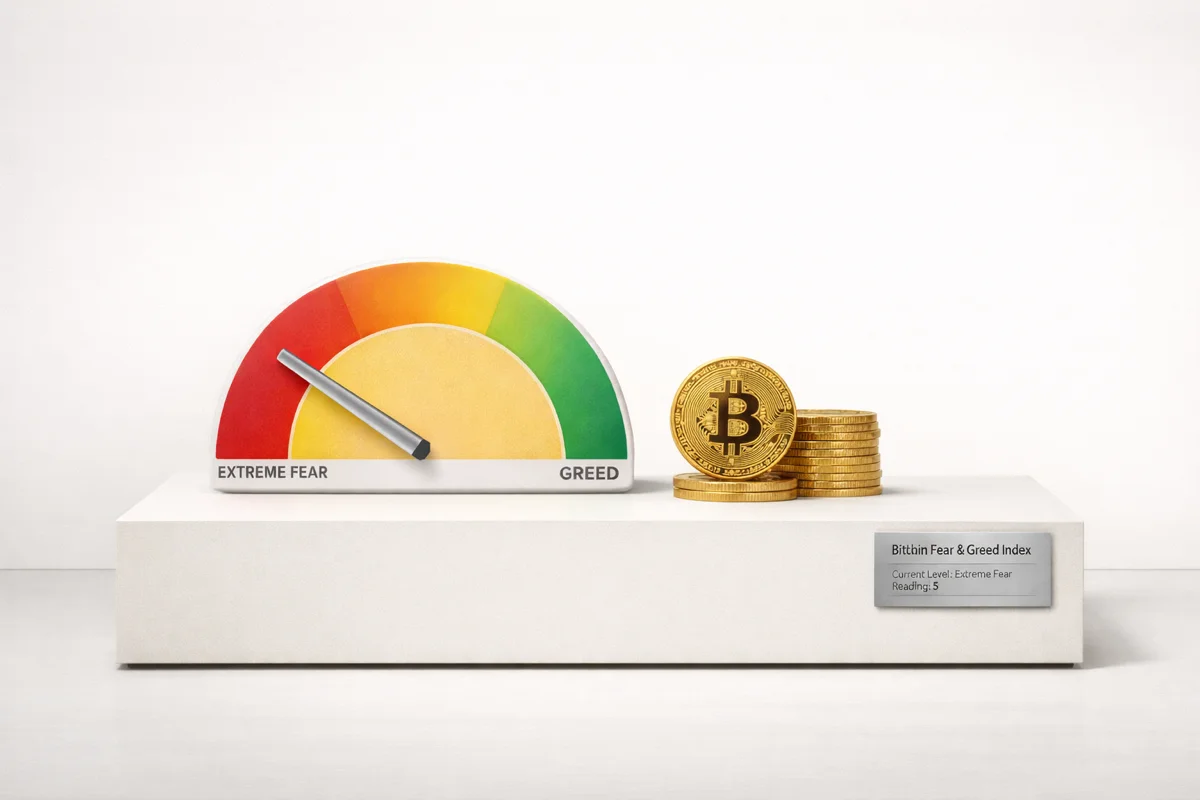
Market sentiment indicators corroborate the on-chain picture. The Crypto Fear & Greed Index fell to 5 out of 100 during the February 2026 selloff — an Extreme Fear reading not recorded since 2018.
Sentiment extremes matter as cycle inputs because they reflect positioning. When the Fear & Greed Index reaches single digits, it signals that the majority of retail participants have either sold or are paralyzed by fear — creating the conditions in which disciplined buyers accumulate without competition from the broader market. This is the mechanism behind Warren Buffett's famous instruction to "be greedy when others are fearful."
Glassnode's Accumulation Trend Score and exchange-traded fund (ETF) flow data from the Week 7 2026 report provide additional context: spot demand began showing early stabilization signals even as price remained depressed. This is a typical pattern at cycle inflection points — on-chain accumulation begins before price confirms recovery.
The caveat: sentiment can remain at extremes for longer than expected. In 2018, Fear & Greed stayed deeply negative for months before the recovery gained traction.
Two Scenarios: Accumulation Zone or Continued Pain?
Given the convergence of extreme signals, two frameworks define the forward outlook.
Bull case — historical accumulation zone. The 200DMA — currently sitting at $58,000-$60,000 — has served as the ultimate bear market floor in three previous cycles: 2015, 2019, and 2022, each time at the price level relevant to that cycle. A -2.88 sigma reading at precisely this level, combined with record realized losses (capitulation), 50% supply in loss (structural transfer to strong hands), and Fear & Greed at 5/100 (sentiment exhaustion), historically constitutes a high-quality accumulation signal on a 12-24 month horizon.
Bear case — the Realized P/L Ratio timeline. The 90-day simple moving average (SMA) of the Realized P/L Ratio falling below 1 has, in prior cycles, persisted for six months or longer before recovery was confirmed. If the 2026 cycle follows prior timing, the low may be in — but the recovery phase likely unfolds slowly rather than sharply. Additional macro deterioration (a US recession, global credit event, or regulatory shock) could extend the bear phase beyond historical norms.
Key indicators to monitor: - Realized P/L Ratio 90-day simple moving average (SMA) crossing back above 1 (primary confirmation) - Supply in loss declining from the 50% peak (demand absorption) - Futures OI rebuilding from $49B toward prior ranges (leverage re-engagement) - Fear & Greed recovering and sustaining above 20-25 (sentiment normalization) - Price reclaiming the 200DMA at $58,000-$60,000 on a weekly close basis
Absent these confirmations, the data supports a cautious dollar-cost averaging (DCA) approach rather than concentrated allocation at current levels.
Conclusion: Reading the Signal, Not the Noise
Bitcoin at -2.88 sigma below the 200DMA is a statistically extreme reading that has appeared only at the deepest confirmed bear market bottoms in the past decade. The February 2026 conditions — record $3.2 billion single-day realized losses, nearly 50% of supply underwater, Fear & Greed at 5/100, and the Realized P/L Ratio confirming a structural loss regime — represent a rare convergence of extreme signals across multiple independent metrics.
History does not repeat exactly, but the structural pattern is consistent: these convergences have preceded Bitcoin's largest multi-year recoveries. The critical discipline is distinguishing between a signal that extreme conditions exist and a guarantee that the bottom has been set.
Disclaimer: This article is for informational purposes only and should not be construed as financial advice. Cryptocurrency markets are highly volatile and subject to significant risks. Past performance does not guarantee future results. Consult a qualified financial advisor before making investment decisions.
For investors and analysts, the actionable takeaway is straightforward: track the Glassnode 200DMA chart and the Realized P/L Ratio 90-day SMA as primary forward indicators. When the ratio crosses back above 1 and price reclaims the 200DMA, the structural bear regime will be over. Until then, the data says we are in historically rare territory — which has always, eventually, resolved to the upside.
Track the Primary Metrics Live
- Glassnode 200DMA / 111DMA / 200WMA Chart — the definitive chart for tracking sigma deviation from key moving averages
- Bitbo 50/200 Day MA Chart — historical moving average context across all Bitcoin cycles
Sources
- Bitcoin BTC: 111DMA / 200DMA / 200WMA Chart — Glassnode Studio — Glassnode
- Standard Deviation Channels in Crypto Markets: A Comprehensive Guide — UEEx Technology
- $60,000, BTC price news: Bitcoin spirals toward headed for worst drawdown since FTX crash — CoinDesk (Feb 5, 2026)
- Triggered Bitcoin's What Major Selloff in February 2026? — VanEck
- $63,000 Bitcoin dips under and history says more pain ahead before bottom forms — CoinDesk (Feb 24, 2026)
- Last week's rout delivered bitcoin's biggest realized loss ever — CoinDesk (Feb 12, 2026)
- 50% Nearly of Bitcoin Supply Now in Loss: This Marked the Bottom in the Last Three Cycles — The Crypto Basic (Feb 25, 2026)
- Glassnode: Bitcoin Realized Losses Have Hit Bear Market Levels — CryptoPotato
- Range-Bound Under Pressure — The Week Onchain Week 07, 2026 — Glassnode
- Bitcoin 50/200 Day Moving Average Chart — Bitbo
- Long Could How the 2026 Bitcoin Bear Market Last? — BeInCrypto
- Don't panic yet: Bitcoin has a line in the sand that has saved every bull market since 2015 — CoinDesk (Feb 2, 2026)
Sources
- Glassnode 200DMA / 111DMA / 200WMA Chart — studio.glassnode.com
- Bitbo 50/200 Day MA Chart — charts.bitbo.io
- Standard Deviation Channels in Crypto Markets: A Comprehensive Guide — blog.ueex.com
- BTC price news: Bitcoin spirals toward $60,000, headed for worst drawdown since FTX crash — coindesk.com
- What Triggered Bitcoin's Major Selloff in February 2026? — vaneck.com
- Bitcoin dips under $63,000 and history says more pain ahead before bottom forms — coindesk.com
- Last week's rout delivered bitcoin's biggest realized loss ever — coindesk.com
- Nearly 50% of Bitcoin Supply Now in Loss: This Marked the Bottom in the Last Three Cycles — thecryptobasic.com
- Glassnode: Bitcoin Realized Losses Have Hit Bear Market Levels — cryptopotato.com
- Range-Bound Under Pressure — The Week Onchain Week 07, 2026 — insights.glassnode.com
- How Long Could the 2026 Bitcoin Bear Market Last? — beincrypto.com
- Don't panic yet: Bitcoin has a line in the sand that has saved every bull market since 2015 — coindesk.com